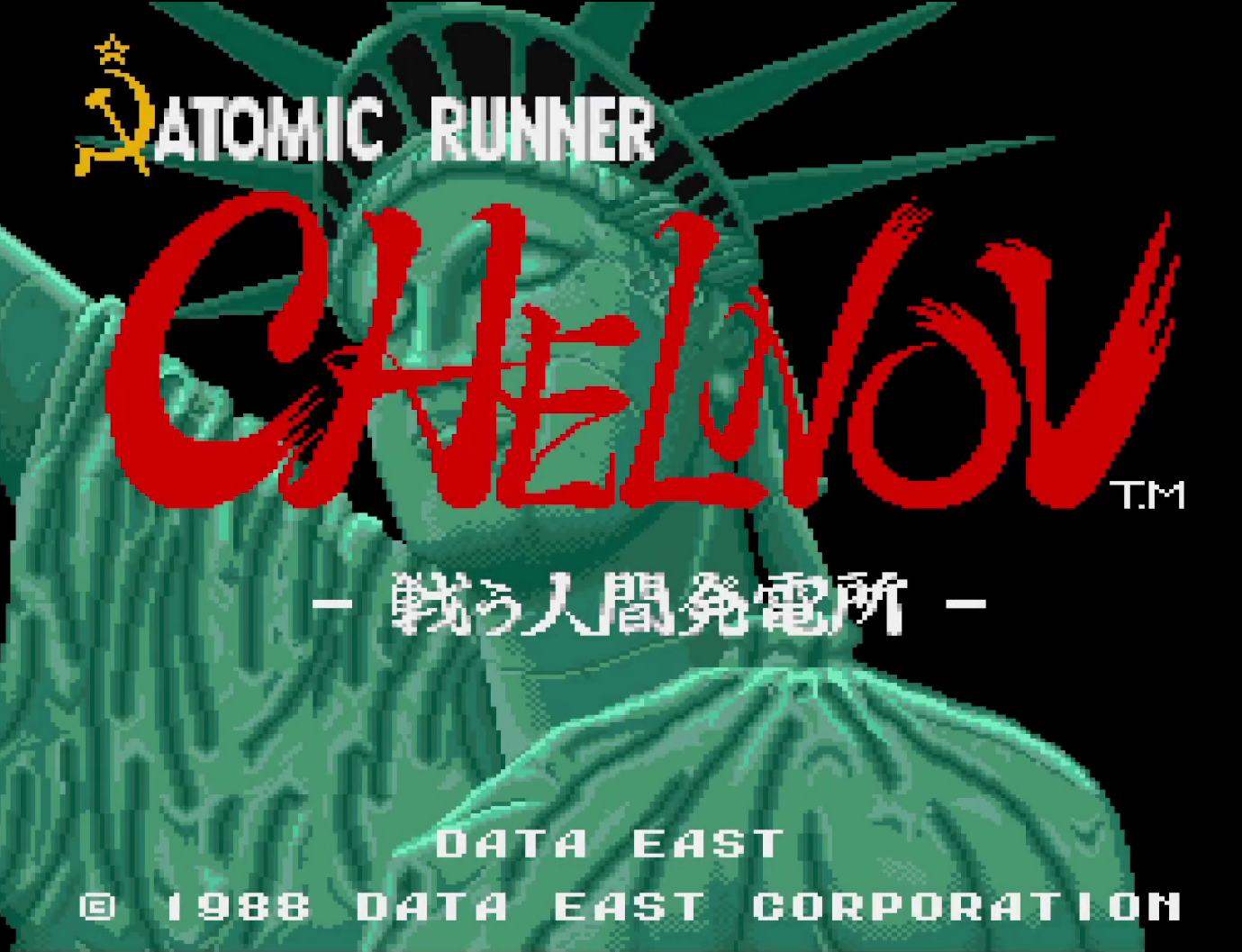
Chelnov – Atomic Runner (1988) Arcade
🧭 Prologue – Echoes of the Atomic Runner
In 1988, Data East released Chelnov, an arcade action title unlike anything else of its era.
Where most platformers encouraged exploration, Chelnov demanded momentum.
The screen never stopped scrolling, the world never paused, and the player was forced into a relentless forward sprint through industrial ruins, mutated landscapes, and mechanical nightmares.
The game’s premise—an ordinary miner transformed by a nuclear blast—captured the anxieties of the late Cold War era.
Yet beneath its radioactive imagery lay a surprisingly elegant design philosophy:
a study in rhythm, pressure, and the exhilaration of survival at full speed.
Chelnov became a cult classic not because of controversy, but because it distilled the arcade spirit into pure kinetic tension.
Today, Chelnov Arcade 1988 stands as a testament to Data East’s experimental edge.
It is a game of motion, mutation, and mastery—an atomic runner whose footsteps still echo across retro gaming history.
🎮 Game Information
Title: Chelnov – Atomic Runner
Year: 1988
Platform: Arcade
Genre: Forced‑Scrolling Action / Run‑and‑Gun
Developer / Publisher: Data East
Format: PCB Arcade Board
Players: 1 Player
🖼️ Exhibit I – Stage Flow & Relentless Momentum
- ⚡ Constant forced scrolling that never allows retreat
- 🎯 Stage design built around pressure, timing, and forward commitment
- 🔄 Power‑ups positioned to reward anticipation rather than reaction
The defining feature of Chelnov is its unbroken forward motion.
Unlike traditional platformers, the player cannot step backward—not even a single pixel.
This transforms every stage into a high‑pressure gauntlet where hesitation is punished and momentum becomes survival.
Each level introduces new hazards: mechanical beasts, organic mutations, industrial traps, and projectile patterns that must be read instantly.
Because the screen scrolls at a fixed pace, the player must commit to decisions early—jumping, ducking, or firing before threats fully appear.
This creates a rhythm closer to a dance than a shooter, where timing and flow matter as much as accuracy.
The brilliance of the design lies in how it weaponizes the environment.
Platforms, slopes, and enemy placements are arranged to push the player into a state of constant adaptation.
Chelnov is not a game of exploration; it is a game of endurance, where the world itself becomes a conveyor belt of escalating danger.

⚙️ Exhibit II – Controls, Power‑Ups & Mutation Design
- 🕹️ Simple inputs: directional movement, jump, attack, and a dedicated turn‑around button
- 💥 Power‑ups dramatically alter attack range, speed, and projectile type
- 🧬 Mutation theme reflected in Chelnov’s evolving firepower
Chelnov uses a minimalist control scheme, yet extracts remarkable depth from it.
The dedicated turn‑around button is essential, allowing the player to fire backward without losing forward momentum—a crucial mechanic in a game where enemies frequently ambush from behind.
Power‑ups form the core of the game’s progression.
Weapons evolve from simple shots to wide‑spread beams, explosive arcs, and high‑speed projectiles.
Each upgrade feels like a mutation, reinforcing the narrative of a human altered by nuclear energy.
Losing a life resets these enhancements, creating a dramatic swing in difficulty and encouraging careful play.
The tension between vulnerability and empowerment defines the experience.
Chelnov is fragile, yet capable of overwhelming force when fully upgraded.
This contrast gives every run a sense of growth, risk, and transformation—mirroring the game’s radioactive theme.
🎼 Exhibit III – Sound, Visual Identity & DECO Aesthetics
- 🔊 Distinctive electronic soundscape shaped by late‑80s arcade hardware
- 🎶 Audio cues reinforce urgency, mutation, and mechanical tension
- 🌌 Layered backgrounds create a sense of depth and industrial decay
Sound and visual presentation are inseparable from Chelnov’s identity.
Data East’s late‑80s arcade hardware produced sharp, metallic tones that perfectly matched the game’s radioactive theme.
Enemy alerts, projectile bursts, and environmental hazards all carry distinct audio signatures, allowing players to react even before threats appear on screen.
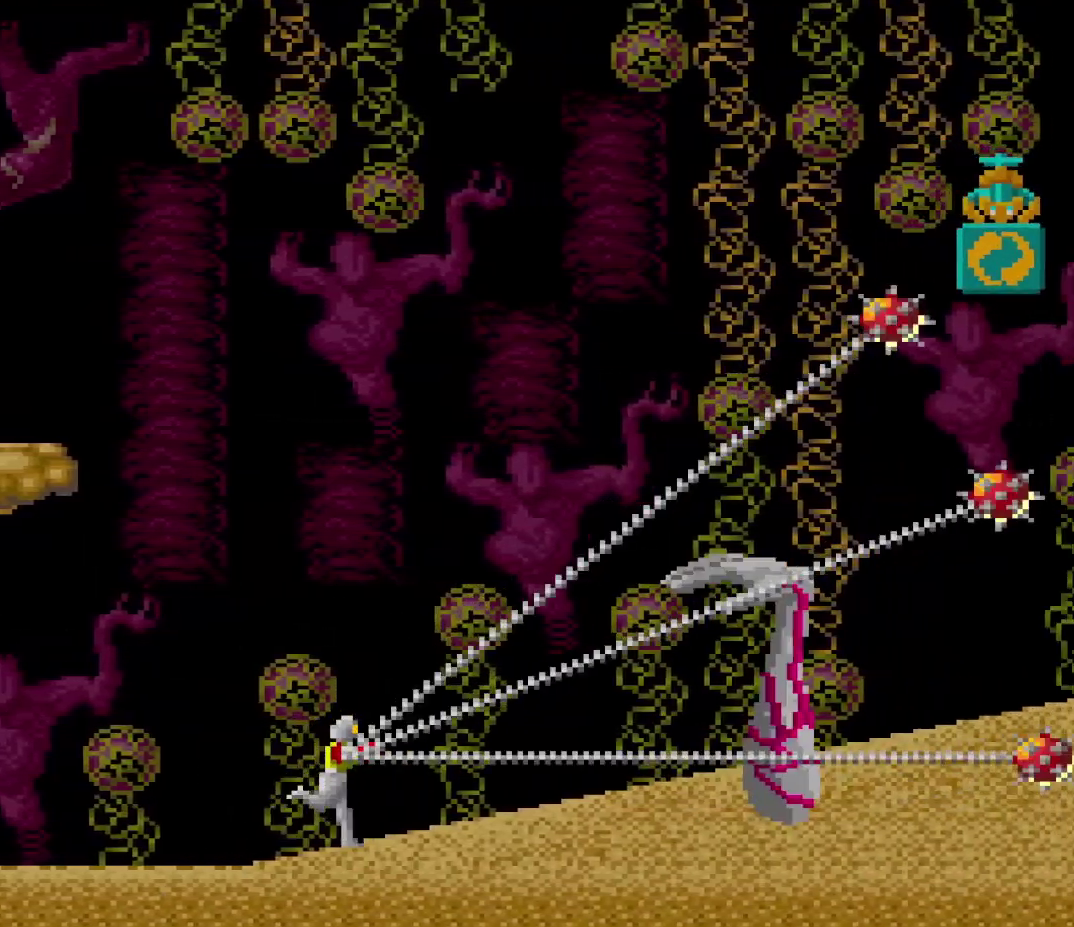
Visually, the game blends industrial ruins with organic mutations, creating a world that feels both mechanical and alive.
Sprite layering simulates depth as machinery pulses in the background and mutated structures loom overhead.
The constant forward motion enhances this effect, turning each stage into a conveyor belt of shifting landscapes.
This synergy between sound and sight is what gives Chelnov its unmistakable atmosphere.
The game does not simply scroll—it surges forward with a rhythm that pulls the player into its radioactive heartbeat.
🧪 Exhibit IV – Technical Background & Cultural Context
- 🖥️ Data East’s arcade board pushed to deliver fast scrolling and dense enemy patterns
- 🌍 Themes echo late‑Cold‑War anxieties and nuclear‑age storytelling
- 🎮 Influenced later “runner‑style” action games and momentum‑based shooters
Technically, Chelnov was ambitious.
Data East’s hardware had to maintain smooth forced scrolling while rendering numerous enemies, particle effects, and layered backgrounds.
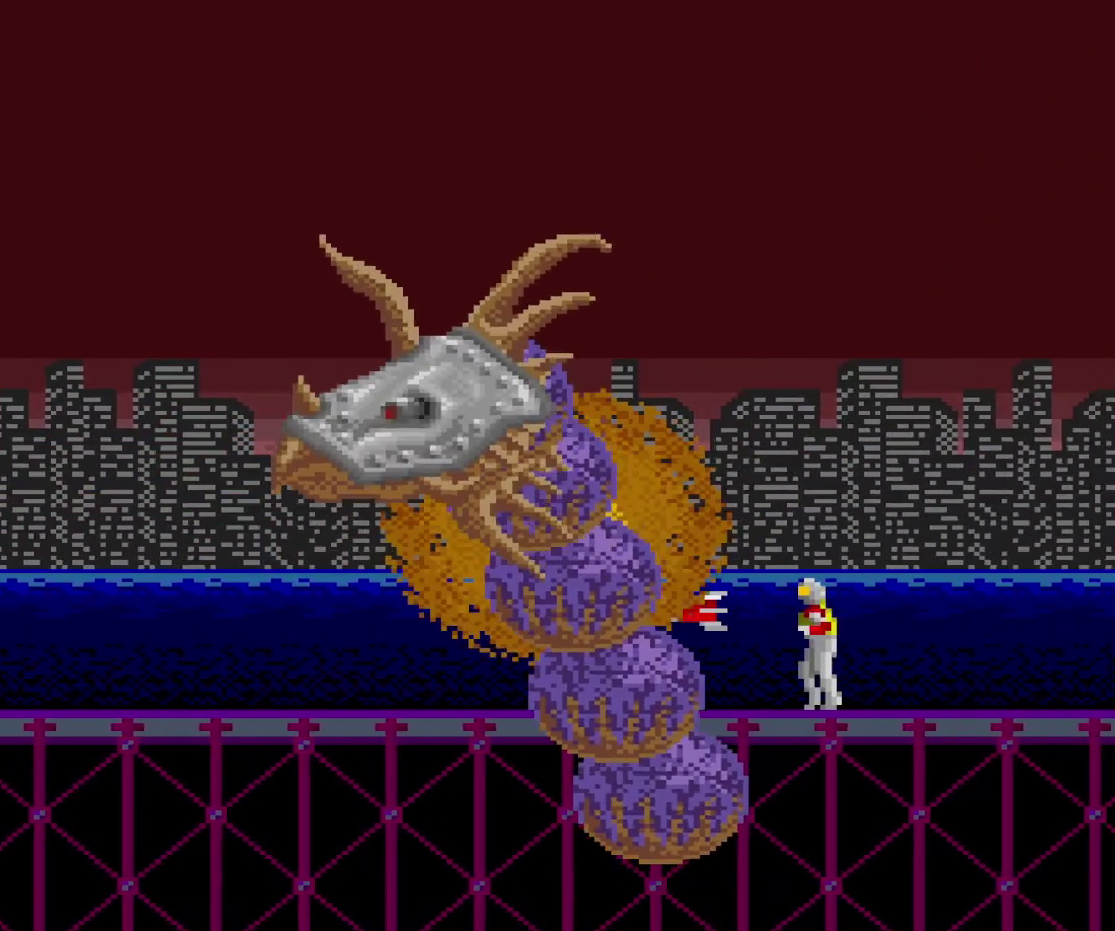
The board’s sprite handling allowed for large bosses, multi‑segment enemies, and rapid projectile patterns without slowdown—an impressive feat for 1988.
Culturally, the game reflected the era’s fascination with nuclear energy, mutation, and post‑industrial landscapes.
The protagonist’s transformation into a “human power plant” mirrored both pulp‑science tropes and real‑world anxieties.
Although the name “Chelnov” sparked debate, the game itself is better understood as a product of its time: a fusion of arcade spectacle and Cold‑War imagination.
Its influence can be seen in later momentum‑driven action titles, especially those that emphasize constant movement and evolving firepower.
Chelnov stands as a bridge between traditional platform shooters and the emerging philosophy of “runner‑style” arcade design.

🏛️ Epilogue – Running Through the Atomic Horizon
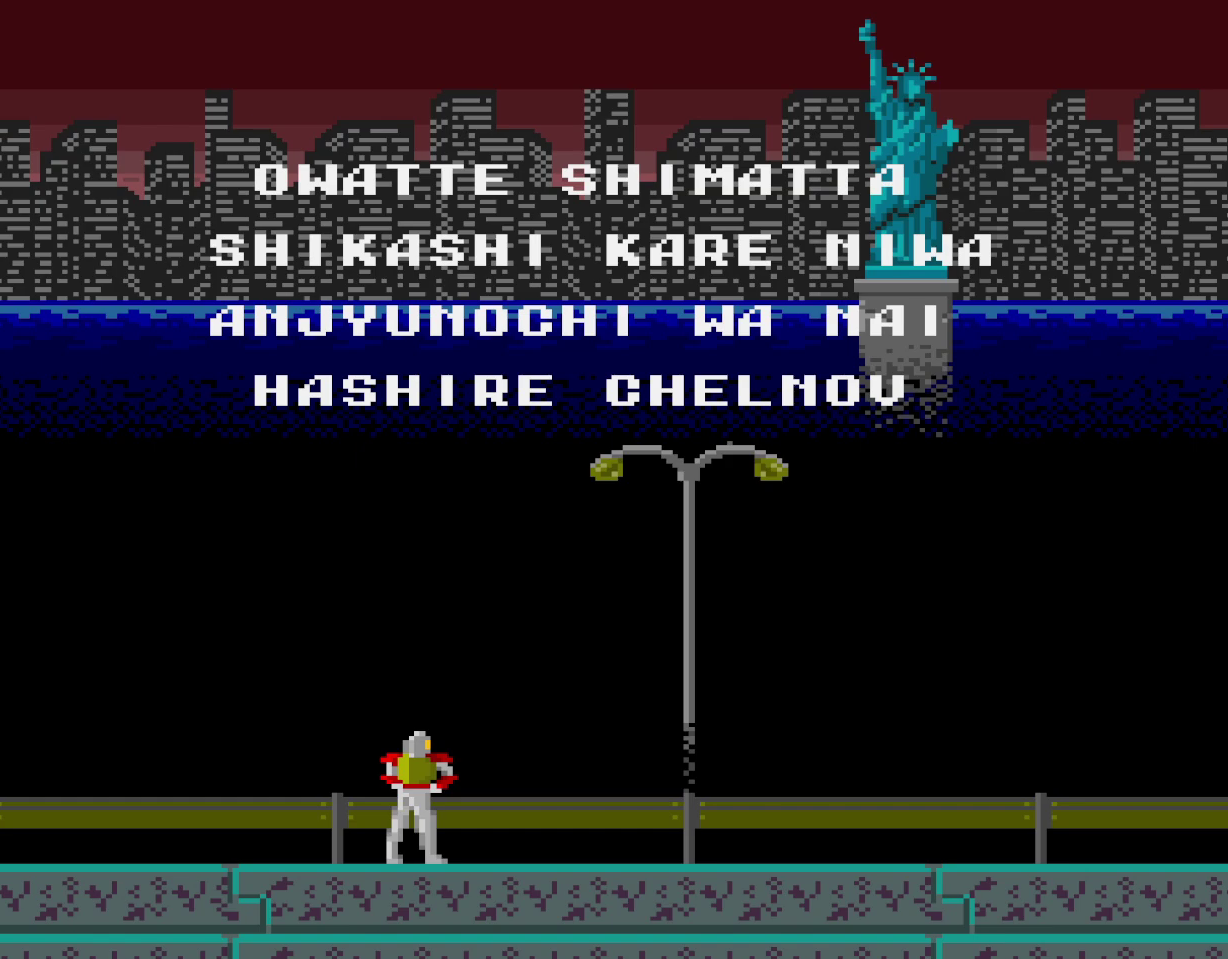
As the final battle ends, Chelnov stands before the distant Statue of Liberty, the words
“OWATTE SHIMATTA SHIKASHI KARE NIWA ANJYUNOCHI WA NAI HASIRE CHELNOV” appearing in romanized Japanese.
It is a strange, poetic farewell—an ending that suggests victory, yet denies rest.
This duality captures the essence of the arcade era.
Chelnov is not a story of closure, but of persistence.
The hero runs because the world demands it; the player continues because mastery is its own reward.
In 1988, this relentless momentum mirrored the arcade itself: loud, urgent, unforgiving, and exhilarating.
Decades later, the memory of sprinting through radioactive ruins, dodging mechanical beasts, and unleashing mutated firepower still resonates with retro enthusiasts.
Chelnov reminds us that even in a world shaped by danger and decay, motion becomes meaning.
The atomic runner continues forward—not because he must, but because the journey itself is the victory.
🎥 Video Exhibit – Chelnov (1988, Arcade)
© 2025 Japanstyle-RetroPlay
Screenshots © Data East 1988
This article is intended for personal documentation and cultural appreciation.
All rights to game footage, music, and characters belong to their respective copyright holders.
🔗 Home | About Us | Site Policy


Comments
Post a Comment